Duaction: The Strategic Shift Where Learning Meets Doing
A few years ago, a startup founder I met at a co-working space had shelves full of business books, online course certificates, and notebooks filled with ideas. Yet his product was still unfinished. He wasn’t lacking information. He was stuck between learning and doing. That invisible gap is where momentum dies—and it is exactly where duaction begins.
Duaction is not a buzzword designed to impress. It is a response to a modern problem: we live in an age of endless knowledge but limited execution. For entrepreneurs, tech readers, and founders, duaction represents a mindset where learning and action are no longer separate phases. They happen together, reinforcing each other in real time.
This article explores duaction as a practical philosophy, explains why it matters now more than ever, and shows how it quietly reshapes the way successful people build, adapt, and grow.
Understanding Duaction in the Modern Context
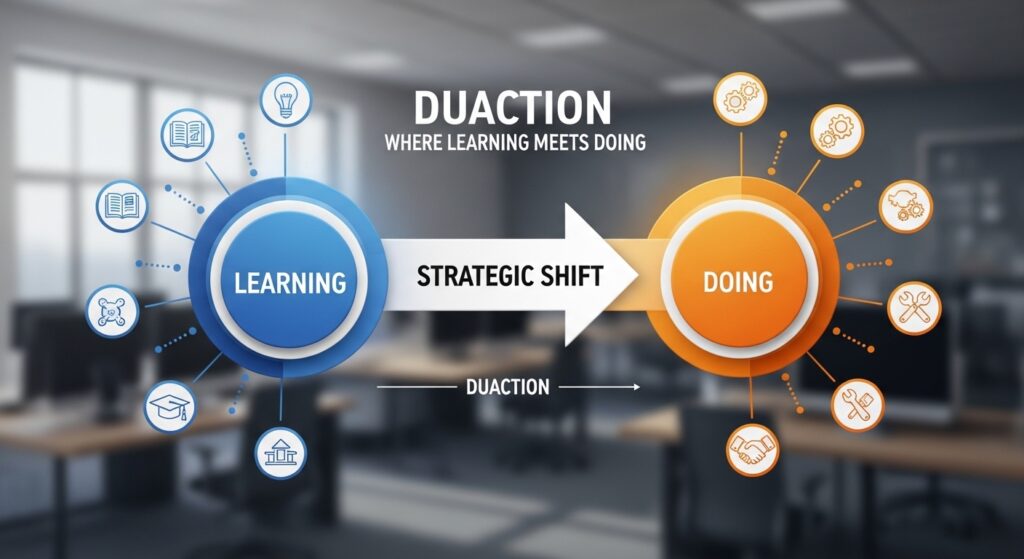
Duaction is the intentional fusion of education and execution. Instead of learning first and acting later, duaction encourages immediate application of insights, even while understanding is still forming. It accepts that clarity often comes after movement, not before it.
Traditional models reward preparation. You study, plan, analyze, and only then act. Duaction challenges this sequence by recognizing that many real-world problems cannot be fully understood in theory. Markets shift, users behave unpredictably, and technology evolves faster than any syllabus can track.
In this context, becomes a survival skill. It allows individuals and teams to learn from real outcomes instead of hypothetical scenarios. Knowledge stops being static and starts behaving like a living system—constantly updated through experience.
Why Duaction Matters More Than Pure Education
Formal education remains valuable, but it has limits. It is often slow, standardized, and disconnected from immediate needs. Duaction fills that gap by grounding learning in urgency and relevance.
When you operate through every action becomes a lesson, and every lesson informs the next action. This loop creates momentum. Instead of waiting to feel ready, you become ready by doing.
For founders, this approach reduces paralysis. For tech professionals, it shortens feedback cycles. For entrepreneurs, it turns mistakes into data instead of failures. Duction reframes progress as something iterative rather than linear.
Duaction and Decision-Making Under Uncertainty
One of duaction’s strongest advantages is how it changes decision-making. In uncertain environments, waiting for perfect information is often more dangerous than acting with partial clarity.
Duaction encourages informed movement. You gather enough insight to take a step, observe the results, and adjust. This is not reckless behavior; it is responsive behavior. It values adaptability over certainty.
In practice, this means launching a minimum version of a product, testing a concept with real users, or making strategic changes based on current signals rather than outdated assumptions. Duaction respects complexity by engaging with it directly.
How Duaction Shapes Entrepreneurial Growth
Entrepreneurs who embrace tend to grow faster—not because they know more, but because they learn better. They understand that progress is built through cycles, not leaps.
Instead of spending months refining a plan, they test early. Instead of overanalyzing competitors, they engage customers. Instead of polishing ideas in isolation, they expose them to reality.
This approach builds resilience. Each action, successful or not, adds to experience. Over time, creates founders who are less afraid of uncertainty and more skilled at navigating it.
Duaction Versus Traditional Learning Models
To understand the contrast clearly, consider the difference between static learning and -based learning:
| Aspect | Traditional Learning | Duaction Approach |
|---|---|---|
| Timing | Learn first, act later | Learn while acting |
| Feedback | Delayed or theoretical | Immediate and real |
| Risk | Avoided early | Managed continuously |
| Growth | Linear | Iterative |
| Relevance | Often generic | Context-specific |
This comparison shows why feels more aligned with real-world demands. It does not replace learning; it accelerates and sharpens it.
Duaction in Technology and Innovation
Technology evolves too quickly for static knowledge to stay relevant for long. Duction thrives in this environment because it prioritizes adaptability over mastery.
Developers learn new frameworks by building with them. Product managers understand users by releasing features and observing behavior. Startup teams refine strategies by responding to real metrics, not forecasts alone.
In tech culture, often appears as rapid prototyping, agile development, and continuous deployment. These practices succeed because they accept one truth: understanding improves through engagement, not isolation.
Psychological Shifts Behind Duaction
Duaction is not just a strategy; it is a psychological shift. It requires letting go of perfectionism and redefining competence. Instead of measuring intelligence by how much you know, measures effectiveness by how well you learn from action.
This mindset reduces fear of mistakes. Errors become signals rather than verdicts. Progress becomes less about confidence and more about curiosity.
People who practice often report higher motivation. Action creates energy. Movement generates clarity. Waiting, on the other hand, often amplifies doubt.
Duaction as a Leadership Philosophy
Leaders who operate through duacton create cultures of experimentation. They encourage teams to test ideas, share learnings, and iterate openly. This builds trust and speed.
Rather than demanding certainty before approval, -based leaders ask better questions: What can we try now? What will we learn? How quickly can we adjust?
This style of leadership is especially powerful in fast-moving industries where rigid planning can quickly become irrelevant. Duacton keeps organizations responsive without becoming chaotic.
Common Misunderstandings About Duaction
Duaction is sometimes misunderstood as impulsive behavior. In reality, it is structured responsiveness. It still values insight, but it refuses to wait indefinitely for it.
Another misconception is that ignores strategy. The opposite is true. Strategy in is dynamic. It evolves with evidence instead of resisting it.
Finally, is not about working faster at all costs. It is about learning smarter through engagement, reflection, and adjustment.
The Long-Term Impact of Duaction
Over time, duaction builds compound intelligence. Each cycle of action and reflection deepens understanding. This creates individuals and organizations that are not just skilled, but adaptable.
In a world defined by volatility, adaptability becomes the most valuable asset. Daction nurtures that asset daily, quietly shaping better decisions, stronger products, and more resilient careers.
Conclusion
Duaction is not a trend—it is a response to reality. As information becomes abundant and change accelerates, the ability to merge learning with action defines who moves forward and who stalls.
For entrepreneurs, tech readers, and founders, offers a grounded way to grow without waiting for certainty. It transforms uncertainty into feedback and effort into insight.
The future will favor those who act thoughtfully, learn continuously, and adapt quickly. In that future, is not optional. It is essential.