
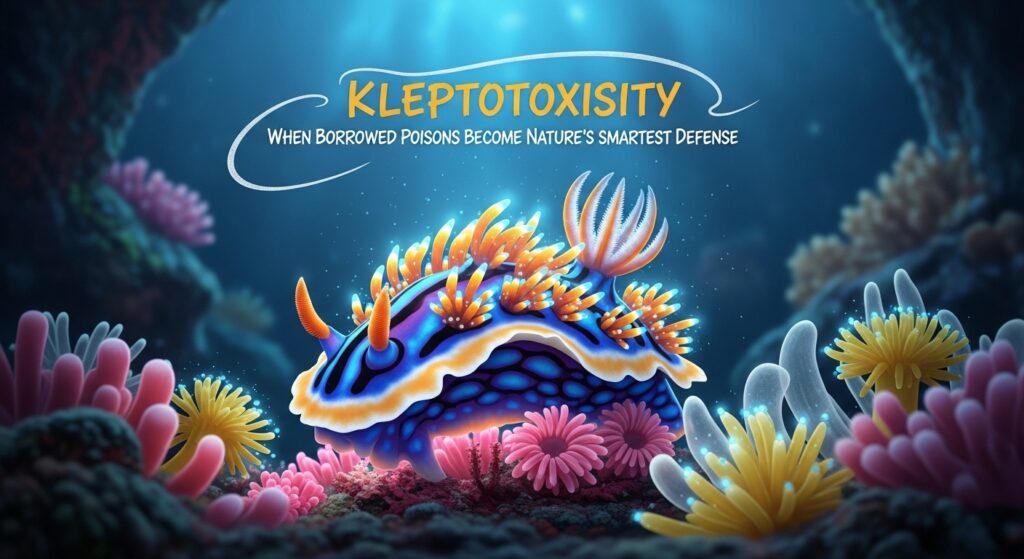
Kleptotoxicity: When Borrowed Poisons Become Nature’s Smartest Defense
On a shallow coral reef, a small sea creature drifts quietly through the water. It doesn’t chase prey or brandish claws. It has no sharp teeth or kleptotoxicity heavy armor. Yet almost nothing dares to eat it. Predators that try quickly learn a painful lesson: this seemingly harmless animal carries powerful toxins.
The surprising part is that the creature didn’t produce those toxins itself.
This remarkable biological strategy is known as kleptotoxicity—a survival tactic in which an organism captures toxins from another species and repurposes them for its own defense. In the natural world, where survival often depends on evolving complex chemical weapons, kleptotoxicity represents an ingenious shortcut: instead of manufacturing poison, some organisms simply borrow it.
For scientists, the phenomenon reveals a fascinating layer of ecological interaction. For innovators and thinkers, it offers an unexpected metaphor for adaptation, resourcefulness, and the strategic reuse of existing assets.
Understanding Kleptotoxicity
At its core, kleptotoxicity describes the process by which an organism acquires toxins from another organism and stores or deploys them as its own defense mechanism.
The word itself combines two Greek roots: klepto, meaning “to steal,” and toxicon, meaning “poison.” Together, they describe an evolutionary strategy that is both efficient and remarkably sophisticated.
Unlike animals that produce toxins internally—such as venomous snakes or poisonous frogs—kleptotoxic organisms rely on external sources. They consume toxic prey or symbiotic partners and then store the chemical compounds inside specialized tissues or cells. When threatened, they release or display those compounds to deter predators.
This strategy highlights a deeper truth about ecosystems: survival often depends less on brute strength and more on creative adaptation.
The Evolutionary Logic Behind Borrowed Poison
Producing toxins internally is expensive from a biological perspective. It requires energy, specialized metabolic pathways, and genetic adaptations that may take millions of years to evolve.
Kleptotoxicity bypasses much of that cost.
Instead of building the machinery to synthesize poison, organisms simply harvest ready-made chemical defenses from their food or environment. This approach allows species to gain protective advantages without the metabolic burden of producing toxins themselves.
Evolution tends to reward efficiency, and kleptotoxicity exemplifies that principle.
However, this strategy is not as simple as just eating something toxic. Organisms that use kleptotoxicity must also evolve mechanisms to:
-
Avoid poisoning themselves
-
Safely store toxins in specialized tissues
-
Deploy the toxins effectively when threatened
In many cases, this requires complex physiological adaptations that make kleptotoxic species just as remarkable as toxin-producing ones.
A Look at Animals That Use Kleptotoxicity
Several species across different ecosystems have evolved kleptotoxic strategies. Most are small marine organisms, but their chemical defenses can be surprisingly powerful.
Below is a simplified comparison of a few known examples.
| Organism | Source of Toxins | How the Toxins Are Used |
|---|---|---|
| Certain sea slugs | Toxic algae or sponges | Stored in skin or tissues for predator deterrence |
| Nudibranchs | Poisonous cnidarians | Toxins retained in external appendages |
| Some flatworms | Toxic prey species | Chemical defense against fish predators |
| Marine worms | Toxic microorganisms | Defensive secretion during threats |
In each case, the organism consumes something toxic and retains the chemicals instead of breaking them down during digestion. The toxins become part of the animal’s defensive arsenal.
This chemical recycling represents one of nature’s most efficient defense strategies.
How Sea Slugs Turn Stolen Toxins Into Weapons
Among the most famous kleptotoxic organisms are nudibranchs—vibrantly colored sea slugs often found in coral reefs.
These creatures frequently feed on toxic animals such as jellyfish, sea anemones, or sponges. Instead of digesting the toxins completely, they transport them into specialized structures called cerata, finger-like projections along their backs.
When a predator attacks, the stored toxins act as chemical deterrents.
Some species take the strategy even further. They capture entire stinging cells from their prey—tiny biological weapons originally designed to paralyze enemies—and relocate them into their own tissues. When threatened, the sea slug can trigger those same stinging cells against predators.
The result is a creature that effectively repurposes another species’ weaponry.
In the arms race of evolution, that’s a clever advantage.
Chemical Defense as a Communication Signal
Interestingly, kleptotoxicity doesn’t only protect organisms physically. It can also act as a warning signal.
Many kleptotoxic animals display bright, contrasting colors—a phenomenon known as aposematism, where vivid coloration warns predators that an organism is toxic or dangerous.
The colors serve as a visual announcement: “Don’t eat me.”
Over time, predators learn to associate those colors with unpleasant experiences. Even if a predator has never encountered that specific species before, the visual cues may discourage attacks.
In this way, kleptotoxicity becomes part of a larger evolutionary communication system between predators and prey.
Ecological Ripple Effects
Because kleptotoxic organisms depend on specific toxic prey, their presence often reflects the health and complexity of an ecosystem.
For example, certain sea slugs can only obtain toxins from specific sponge or coral species. If those organisms disappear due to pollution, warming waters, or habitat destruction, the kleptotoxic species may vanish as well.
This makes kleptotoxic organisms valuable indicators of biodiversity.
Their survival depends on a delicate chain of ecological relationships:
toxic prey → kleptotoxic consumer → predator deterrence.
Break one link in the chain, and the entire system can collapse.
What Scientists Are Learning From Kleptotoxicity
Researchers studying kleptotoxicity are uncovering insights that extend beyond marine biology.
Chemical compounds used in defensive toxins often possess potent biological activity. Some have shown potential for:
-
pharmaceutical research
-
antimicrobial treatments
-
cancer therapies
By studying how animals acquire, store, and tolerate these compounds, scientists may discover new ways to harness similar chemicals for human medicine.
In addition, understanding toxin storage mechanisms could help researchers develop safer drug delivery systems, where powerful compounds are stored and released in controlled ways.
Nature’s solutions often inspire technological breakthroughs.
Kleptotoxicity is one such example.
A Strategic Lesson Beyond Biology
Although kleptotoxicity is a biological phenomenon, the concept resonates far beyond ecology.
In business, technology, and innovation, success often comes from repurposing existing resources rather than building everything from scratch.
Many transformative ideas follow a similar logic:
Instead of inventing entirely new systems, innovators combine existing tools in unexpected ways.
Examples appear everywhere—from open-source software ecosystems to startup companies that build new platforms on top of existing infrastructure.
The parallel is striking: just as kleptotoxic organisms repurpose toxins for defense, modern innovators often repurpose existing technologies to create new competitive advantages.
Nature, once again, offers a masterclass in strategic efficiency.
The Risks of Borrowed Weapons
Despite its advantages, kleptotoxicity carries risks.
The organism must maintain a reliable supply of toxic prey. If food sources change, the defense system may weaken or disappear entirely.
Additionally, storing toxins requires precise biological control. Too much toxin—or improper storage—could harm the organism itself.
Predators may also adapt over time. Some animals evolve resistance to specific toxins, weakening the effectiveness of the borrowed defense.
In evolutionary terms, kleptotoxicity is not a permanent solution but part of an ongoing arms race between predators and prey.
The Beauty of Chemical Ecology
One of the most fascinating aspects of kleptotoxicity is how it reveals the invisible chemical conversations happening in nature.
We often think of ecosystems in terms of physical interactions: animals eating plants, predators chasing prey, organisms competing for territory.
But beneath those visible relationships lies a hidden world of chemistry.
Molecules act as signals, defenses, deterrents, and weapons. Entire survival strategies revolve around chemical compounds that cannot be seen by the naked eye.
Kleptotoxic organisms sit at the center of this chemical battlefield, transforming the toxins of one species into the protective shield of another.
It’s a reminder that evolution often rewards creativity more than strength.
Why Kleptotoxicity Continues to Fascinate Scientists
Scientists remain captivated by kleptotoxicity because it challenges simple assumptions about how organisms evolve defenses.
Traditional models of evolution suggest that traits develop internally through genetic mutation and natural selection.
But kleptotoxicity shows that organisms can also acquire functional advantages from their environment in surprising ways.
It demonstrates that evolution is not only about developing new tools—it is also about learning how to use the tools that already exist.
This flexibility may explain why kleptotoxic strategies appear across multiple unrelated species.
When nature discovers an efficient solution, evolution tends to reuse it.
Conclusion
In a world that often celebrates invention, kleptotoxicity highlights another powerful strategy: intelligent reuse. From sea slugs collecting toxins to innovators building new technologies on existing platforms, the principle is remarkably similar.
Sometimes it comes from recognizing value where others do not—and transforming it into an advantage. Nature has been practicing this strategy for millions of years. Kleptotoxic organisms are simply the latest reminder that survival often belongs to the most resourceful.